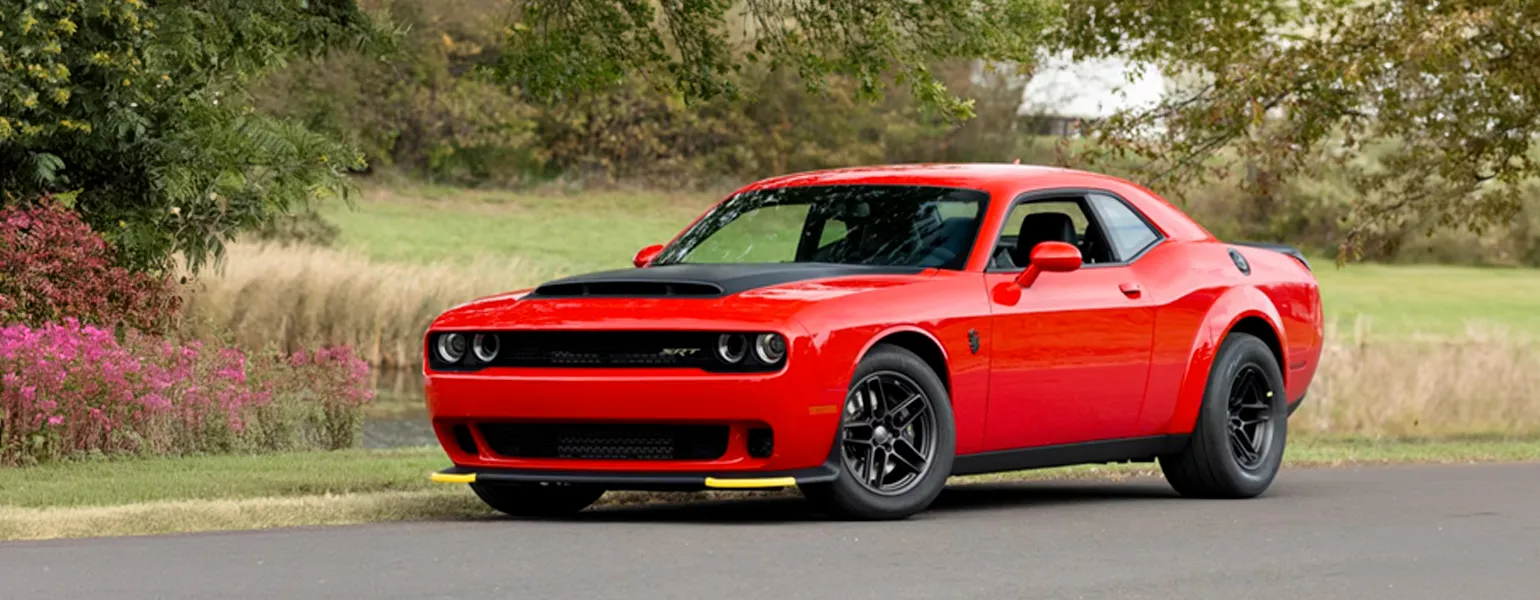
For 20 years, Americans have been serving us a “revival” of muscle cars from the 1960s. Mustang and Camaro played the Phoenix, offering over 400 hp. like lily of the valley around the corner on May 1. The Dodge Challenger followed suit in 2008. But at the dawn of her retirement, she started a different genre. Dodge's SRT division delivers a final edition whose compressed 6.2-liter V8 delivers 1039 hp. (!) if it is powered by E85 for 1285 Nm of torque! And all this for the modest sum of 96,666$ excluding VAT, or about 100€ per horse. It is 5 to 10 times cheaper than elsewhere and the 0 to 100 km/h is shipped in 2 seconds, apparently!
At the time, the sector was populated by tiny structures, passionate, admittedly, but unable to meet the expectations of a modern owner. For us, maintaining a car is more than just an oil can or maintaining the load. It means understanding its market value, anticipating its mechanical weaknesses, insuring it, reselling it, looking for the next one, in short: digitizing the soul of your vehicles to predict the unpredictable.
Ten years after the arrival of the Huracán, Lamborghini is opening a new chapter. The naturally aspirated V10 bows out and gives way to a completely new mechanism: a hybrid twin-turbo V8, developed entirely by Sant'Agata. His name, Temerario, summarizes this transition well. Bold, assertive, and looking to the future.
The car is constantly evolving. If you think of supercars, from the Lamborghini Miura to the McLaren P1, you imagine pure speed, the roar of the engines and the sculpted lines for aerodynamics. However, another movement, more discreet but just as powerful, has changed the world of performance: the rise of sporty SUVs.
Didn't find the answer you were looking for?
Contact us, and an expert will respond promptly.